Phone:
(701)814-6992
Physical address:
6296 Donnelly Plaza
Ratkeville, Bahamas.

You may know what Canada’s climate is like, and definitely, you’ve heard that this country is associated with cold weather and snow. But it’s interesting to know that Canada enjoys four distinct seasons, and daytime temperature in summer may rise to 35 °C and higher, and decreasing to -25°C is not uncommon in winter, thanks to heated houses infrastructure. Autumn is cool and colored by rich orange and red leaves on trees, and for good news, spring is generally pleasant.
Table of Contents
The average winter and summer temperatures vary across Canada according to the location. The most significant part of Canada has a continental climate, though. Winters may be harsh in many country regions, particularly in Prairie Provinces, which experience a continental climate.
The daily average temperatures in these areas can be near -15 degrees Celsius; this temperature can even drop below -40 degrees Celsius with severe wind chills. Snow can cover the ground six months of the year in noncoastal regions. The following table shows Canada’s average low, average, and average high temperatures of weather stations in provinces and territories across Canada based on the climate period from 2016 to 2020.
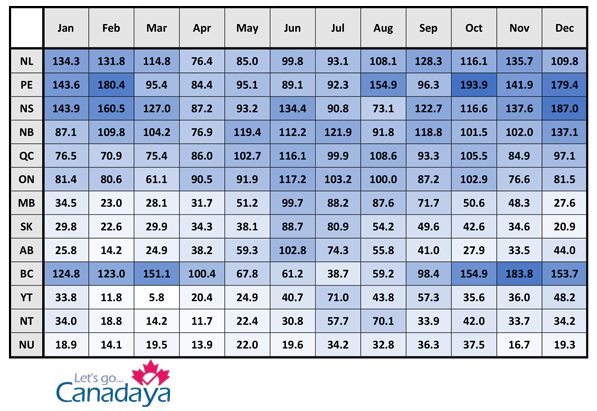
Since Canada is one of the windiest countries globally, a large amount of wind energy was built in Canada between 2009 and 2019. This energy is generating enough power to supply the power of over three million Canadian homes. The following tables show each province and territory’s normal annual wind speed, in kilometers per hour (km/h) by month:
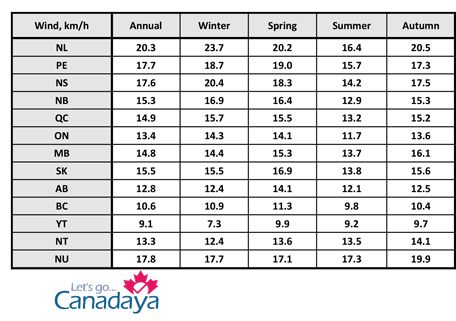
The average wind speed in kilometers per hour in Canada’s provinces and territories by season and year:
Canada’s climate has been getting wetter since the mid-1970s. Rainfall in Canada varies in the arid regions from the mountains annually. The southern temperate areas receive up to 1016mm of rainfall evenly throughout the year. Snowfall is abundant in the north, receiving the least sunshine of fewer than 1500 hours annually. The average monthly rainfall in each province and territory in recent years is as follows:
The average rainfall in Canada provinces and territories by season and year in recent years is as follows:
Since there was no valid data for PEI in the reference period, 2008-2012 was the calculation reference.
Based on the studies, Canada ranks 9th among the 33 richest and cleanest countries on the planet for overall air quality. Compared to other countries, air pollution levels are relatively low. With the release of pollutants, pollution problems such as fog, smoke, and acid rain are created in the atmosphere. These pollutants are released due to human activities such as transportation, burning fuel for electricity and heating, and various industrial activities. However, air pollution still is remained as a concern for the Government of Canada.
In a glance at Canada’s climate, we find out that
So far, we have talked about Canada’s climate. You noticed that Canada has a continental climate. However, this country may be harsh in some regions. You also get familiarized with Canada’s average temperature, average annual wind speed, and average precipitation. We hope you have enjoyed reading this article
Thank you, dear audiences, for your attention. Now that you’ve learned more about Canada let us know if you want to know more about Canada’s geography. You can also read more about Canada’s Politics, Economy, Socio-cultural, and history.